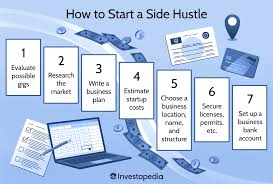
There’s a moment most solopreneurs recognize in hindsight — the exact point where their side hustle stopped being a hobby and became a real business. Maybe it was the month the income replaced their salary. Maybe it was the first time a client asked for a W-9 before paying them. Maybe it was April, staring at a tax bill they didn’t see coming, wondering where the money went and why nobody told them it would feel like this. Nearly 29.8 million Americans now run businesses entirely on their own, contributing $1.7 trillion to the U.S. economy — and the vast majority of them made the transition from casual earner to structured business owner without a roadmap. That’s what this checklist is for. Whether you’re six months into a side hustle that’s picking up steam or two years in and realizing your financial systems haven’t kept pace with your income, getting payroll and documentation right is the single highest-leverage move you can make right now. And practical tools like a free paystub generator are exactly the kind of resource that lets you create professional, compliant income records without a payroll department — or a monthly software subscription — standing between you and your next level.
Why “Payroll” Matters Even When You’re the Only Employee
Most solopreneurs skip payroll thinking because they don’t have employees. That’s the first mental block to clear.
Payroll for a solopreneur isn’t about paying other people — it’s about how you pay yourself, how you document that payment, and what the IRS expects to see based on how your business is structured. Getting this wrong doesn’t just create accounting headaches. It creates tax penalties, compliance risk, and a paper trail that can’t support the financial life you’re building — the apartment lease, the mortgage application, the business loan.
<invoke name=”web_search”>
Here’s the foundational reality: your business structure determines everything about how you pay yourself. And the IRS treats every structure differently.
Part 1: Choose the Right Business Structure First
Before you can build a payroll system, you need to know what kind of entity you’re running. This isn’t a bureaucratic formality — it’s the foundation that determines your tax obligations, liability exposure, and how money legally moves from your business to your personal account.
Sole Proprietorship
The simplest structure and the default if you’ve started earning without filing any formal paperwork. You and your business are legally the same entity. You take an owner’s draw — simply withdrawing money from business profits — whenever you need funds. Everything flows through your personal tax return (Schedule C, Form 1040).
Advantages: Zero setup cost, minimal administration, easy to understand.
Disadvantages: No liability separation between your personal assets and business debts; you pay self-employment tax (15.3%) on all net profits, regardless of how much you actually draw.
Most solopreneurs start here by default. There’s nothing wrong with it — but if you’re consistently earning above $50,000–$75,000 in net profit, you’re almost certainly leaving money on the table by staying a sole proprietor.
Single-Member LLC
A Limited Liability Company with one owner creates legal separation between your personal assets and your business liabilities. For tax purposes, the IRS treats a single-member LLC exactly like a sole proprietorship by default — income flows through to your personal return, and you pay self-employment tax on all net profits.
The LLC is the recommended structure for most solopreneurs because of the personal liability protection it provides, without adding significant administrative complexity. Formation costs vary by state but typically range from $50 to $500 as a one-time filing fee.
S-Corporation
Here’s where payroll becomes a formal, structured obligation — and a significant tax planning opportunity.
When your net profit consistently reaches or exceeds approximately $75,000–$80,000, electing S-Corp tax treatment (by filing IRS Form 2553) can generate meaningful tax savings. The structure works like this: instead of paying self-employment tax on all net profits, you pay yourself a “reasonable salary” (subject to payroll taxes), and take the remaining profit as an S-Corp distribution — which is not subject to self-employment tax.
For a solopreneur earning $120,000 net profit annually, the difference between a sole proprietorship and an S-Corp structure could represent $8,000–$15,000 in annual tax savings, depending on the salary elected and state tax treatment.
The trade-off: S-Corps require formal payroll, including regular W-2 paychecks to yourself, quarterly payroll tax filings, and the maintenance of documented, IRS-auditable payroll records. The IRS specifically watches for S-Corp owners paying themselves suspiciously low salaries to minimize payroll taxes — your salary must be “reasonable” for your role and industry.
Checklist: Business Structure Step
- [ ] Identify your current structure (sole proprietor by default, LLC, or corporation)
- [ ] Estimate your annual net profit
- [ ] Research whether your income level warrants LLC formation or S-Corp election
- [ ] Consult a CPA if you’re near or above the $75,000 threshold — the savings typically justify the advisory fee
Part 2: Get Your Legal and Tax Identity Right
Once your structure is clear, several foundational administrative steps unlock everything else.
Obtain an Employer Identification Number (EIN)
An EIN is the business equivalent of a Social Security number. The IRS issues them for free at IRS.gov, and the application takes about 10 minutes online. You need an EIN if:
- You operate as an LLC or corporation
- You plan to open a business bank account (most banks require it)
- You hire contractors or employees
- You elect S-Corp tax treatment
Even as a sole proprietor, having an EIN lets you use it instead of your Social Security number on W-9 forms — a meaningful privacy advantage when dealing with new clients.
Open a Dedicated Business Bank Account
Mixing personal and business finances is one of the most common and costly mistakes solopreneurs make. A separate business account:
- Creates a clean record of all business income and expenses
- Simplifies tax preparation significantly (no need to manually sort transactions)
- Provides the documented bank statements that lenders, landlords, and financial institutions expect when you need to prove income
- Strengthens the legal separation between your personal and business finances if you’re an LLC
Checklist: Legal/Tax Identity Steps
- [ ] Apply for an EIN at IRS.gov (free, takes 10 minutes)
- [ ] Open a dedicated business checking account
- [ ] Register your business name with your state if operating under a DBA (“doing business as”)
- [ ] Register with your state’s Secretary of State office if forming an LLC
Part 3: Understand How You Pay Yourself
This is where most solopreneurs operate on instinct rather than system, and it costs them in multiple ways.
Owner’s Draw (Sole Proprietor or LLC)
If you’re a sole proprietor or single-member LLC, you pay yourself by transferring money from your business account to your personal account. There’s no payroll tax withheld at the time of transfer — instead, you pay self-employment tax quarterly through estimated tax payments. The draw itself is not an expense; it reduces the equity in your business.
The practical problem: many solopreneurs take draws erratically, whenever they need money, without any consistent structure. This makes budgeting harder, income documentation more difficult, and quarterly estimated tax payments feel like surprises rather than planned obligations.
The fix: Establish a consistent “pay date” — weekly, bi-weekly, or monthly — and transfer a set amount to yourself on that schedule, just as a paycheck would arrive. This creates the regular payment pattern that banks, landlords, and lenders recognize as evidence of steady income.
W-2 Salary (S-Corp)
If you’ve elected S-Corp status, you must pay yourself a formal salary through payroll. This means:
- Running payroll on a regular schedule (bi-weekly is standard)
- Withholding federal and state income taxes, Social Security, and Medicare from each paycheck
- Issuing yourself a W-2 at year-end
- Filing quarterly payroll tax returns (Form 941) with the IRS
- Making federal tax deposits on a regular schedule
The S-Corp salary is a real, documented payroll transaction — not a transfer between accounts. It requires a payroll system that handles the calculations and filings, not just a bank transfer.
Checklist: How You Pay Yourself
- [ ] Establish a consistent pay frequency (weekly, bi-weekly, or monthly)
- [ ] Set a fixed transfer amount or salary based on sustainable business cash flow
- [ ] Keep transfers or payroll separate from ad-hoc business expenses
- [ ] Document every payment to yourself with dates, amounts, and period covered
Part 4: Set Up Your Income Documentation System
This is the step solopreneurs most often skip — and pay for repeatedly when they apply for a loan, try to rent an apartment, or need to demonstrate income to a client or financial partner.
Documentation isn’t just for the IRS. It’s what allows your business income to function in the financial world the way a W-2 employee’s income does automatically.
Pay Stubs
Even if you’re a sole proprietor taking owner’s draws, generating a pay stub for each pay period creates a professional, standardized record of your earnings. A proper pay stub shows:
- Your business name (as the “employer”) and your personal name (as the “employee”)
- The pay period dates
- Gross earnings for the period
- Estimated federal and state tax deductions
- Social Security and Medicare contributions
- Net pay
This is the format banks, landlords, and lenders immediately recognize — because it’s the same document they see from W-2 employees. Without it, you’re asking every financial institution you interact with to do extra work to understand your income, which slows approvals and often results in higher scrutiny.
Before you start creating pay stubs, spend a moment previewing the exact layout by looking at a free paystub template. Seeing the complete format before you enter a single number ensures you understand every required field — employer information, pay period, deduction line items, year-to-date totals — so that your first stub is complete and professional rather than something that prompts questions from the reviewer. A template preview is a five-minute step that prevents the back-and-forth of having to resubmit corrected documents later.
Invoices
Every client engagement should be invoiced, even if the client pays immediately and without requiring paperwork. Invoices create a dated record of services rendered, the agreed amount, and the payment received. Over time, your invoice history becomes an auditable income ledger that shows both the volume and consistency of your work.
Keep invoices organized by client and date. Many accounting platforms (Wave, FreshBooks, QuickBooks Solopreneur) generate and store invoices automatically and export records by date range — which is exactly what you need for a tax filing or a bank loan application.
Client Contracts
A signed contract that includes the scope of work, payment amount, and payment schedule demonstrates more than just one payment — it demonstrates ongoing or future income. This is particularly valuable for mortgage applications, where lenders want evidence that your income will continue, not just that you’ve earned in the past.
For solopreneurs with recurring clients, a retainer agreement that confirms a set monthly payment is one of the strongest income documents you can hold.
Checklist: Income Documentation System
- [ ] Generate a pay stub for every pay period, formatted with all required fields
- [ ] Invoice every client for every engagement, without exception
- [ ] File invoices organized by client and date
- [ ] Collect and retain signed contracts or engagement letters for all client work
- [ ] Maintain your business bank account statements monthly
Part 5: Master Quarterly Estimated Taxes
Quarterly estimated taxes are not optional — they’re how the IRS collects taxes from people who don’t have an employer withholding on their behalf. Miss them, and you pay penalties. Underpay them, and you pay penalties and interest.
The 2026 Quarterly Deadlines
| Income Period | Payment Due |
| January 1 – March 31 | April 15, 2026 |
| April 1 – May 31 | June 16, 2026 |
| June 1 – August 31 | September 15, 2026 |
| September 1 – December 31 | January 15, 2027 |
How Much to Set Aside
The standard recommendation for solopreneurs is to set aside 25%–35% of gross earnings from every client payment received. The exact percentage depends on your total income, filing status, state of residence, and deductions. As a starting framework:
- Federal self-employment tax: 15.3% (on 92.35% of net earnings)
- Federal income tax: 10%–37% (depending on taxable income bracket)
- State income tax: 0%–13.3% (depending on state)
- Deduct estimated business expenses before calculating net profit
The most practical system: open a dedicated tax savings account and transfer 25%–30% of every client payment into it the same day it arrives. Treat it as untouchable until each quarterly deadline.
The Safe Harbor Rule
To avoid underpayment penalties entirely, you can use the safe harbor rule: pay at least 100% of last year’s total tax liability (or 110% if your prior-year adjusted gross income exceeded $150,000) in four equal quarterly installments. This eliminates penalty risk even if your current-year income exceeds your prior-year income significantly.
Checklist: Quarterly Estimated Taxes
- [ ] Open a dedicated tax savings account separate from your operating account
- [ ] Set aside 25%–30% of every client payment upon receipt
- [ ] Mark all four quarterly deadlines on your calendar
- [ ] Calculate actual quarterly payments using Form 1040-ES or via tax software
- [ ] Make payments at IRS.gov (Direct Pay is free and instant)
Part 6: Manage Your W-9 and 1099 Obligations
As both the operator and payee of your business, you have obligations on both sides of the W-9 and 1099 relationship.
As a Contractor Receiving Payment
Every client who pays you for services needs a completed Form W-9 from you before they can issue a 1099. The W-9 provides your legal name, tax classification, and Tax Identification Number (either your SSN or EIN). Best practice: send a W-9 proactively before starting any new client engagement, rather than waiting for them to request it and potentially delaying payment.
Key 2026 change: The 1099-NEC reporting threshold has increased from $600 to $2,000 for payments made during the 2026 calendar year. This means clients who pay you between $600 and $1,999 in 2026 are no longer required to issue you a 1099-NEC. This doesn’t change your tax obligation — you owe taxes on all income earned, regardless of whether a 1099 is issued — but it does mean less automatic documentation will arrive in your mailbox each January.
The implication: With fewer 1099s being issued, your own income documentation becomes even more important. The invoices, pay stubs, and bank records you maintain are your primary income trail in the absence of client-issued tax forms.
As a Business Paying Contractors
If your solopreneur business grows to include subcontractors or outside help, you inherit the 1099-NEC obligation on your end. For 2026, you must issue a 1099-NEC to any U.S.-based contractor you paid $2,000 or more during the calendar year.
Key deadlines for 2026:
- February 2, 2026: Deadline to send 1099-NEC to recipients
- February 2, 2026: Deadline to file 1099-NEC with the IRS
- March 31, 2026: Deadline to e-file 1099-MISC (if not reporting nonemployee compensation)
Always collect a completed W-9 from any contractor before their first payment — not after.
Checklist: W-9 and 1099 Management
- [ ] Prepare and send a current W-9 to every client before starting work
- [ ] Update your W-9 whenever your business structure or address changes
- [ ] Track all income received, regardless of whether a 1099 will be issued
- [ ] Collect W-9s from any subcontractors before their first payment
- [ ] File 1099-NECs for any contractors paid $2,000+ in 2026 by February 2, 2027
Part 7: Build an Income Proof System That Works Everywhere
The financial world wasn’t designed for solopreneurs. Mortgage applications, car loans, apartment leases, small business credit lines — all of these were built around predictable W-2 income. Your job is to make your income look just as reliable and verifiable as a salaried employee’s, even though your earnings are self-generated.
What a Complete Income Proof Package Looks Like
For any significant financial application in 2026, a solopreneur’s income verification package should include:
- Two to three months of pay stubs — formatted with all required fields, covering consistent pay periods
- Two years of federal tax returns — Form 1040 with Schedule C for sole proprietors; W-2 plus corporate return for S-Corp owners
- Three to six months of business bank statements — showing regular deposits that correspond with stated income
- Active client contracts — demonstrating ongoing income relationships, not just historical earnings
- 1099-NEC forms from major clients, where issued
- A CPA letter for complex income situations or high-earning applications
Every piece reinforces the others. A pay stub that shows $6,000 monthly gross income is much more credible when the bank statement shows $6,000 in corresponding deposits. Two years of tax returns showing growing income tells a story of stability and trajectory. Active contracts signal future earnings, not just past ones.
Consistency Is the Credibility Signal
More than any individual document, financial institutions are looking for consistency. Same pay frequency. Same approximate amounts (with understandable variation). Regular deposits over an extended period. A documented deduction structure that holds up to basic math.
The solopreneurs who lose apartment applications and loan approvals are typically not those with lower income — they’re those whose income is real but whose documentation is sporadic, informal, and hard to read. The fix is entirely within your control.
Checklist: Income Proof System
- [ ] Generate pay stubs on a consistent schedule and keep all copies organized by date
- [ ] Maintain a digital folder with current and prior-year tax returns
- [ ] Download and save monthly business bank statements without gaps
- [ ] Keep a current client roster with active contract amounts on file
- [ ] Review your income documentation package annually — before you need it
Part 8: Know Your Key Deductions
Reducing your taxable income is the other side of the payroll equation. Every dollar of legitimate business deduction reduces the net profit you pay self-employment tax on — which is a 15.3% direct reduction in your tax bill, plus whatever income tax rate applies.
The most commonly missed deductions for solopreneurs:
Home office deduction: If you use part of your home exclusively and regularly for business, a calculated percentage of rent or mortgage interest, utilities, and internet is deductible. The simplified method allows a deduction of $5 per square foot of dedicated office space, up to 300 square feet ($1,500 maximum). The actual expense method often produces a larger deduction.
Business mileage: The 2026 IRS standard mileage rate is $0.725 per mile for business travel. Every client meeting, supply run, and business errand qualifies. Use a mileage tracking app — manual logs are acceptable but tedious.
Self-employment tax deduction: You can deduct 50% of your self-employment tax from gross income before calculating federal income tax. If your SE tax is $8,000, you deduct $4,000 before applying your income tax bracket.
Health insurance premiums: Self-employed individuals can deduct 100% of health insurance premiums paid for themselves and their families as an above-the-line deduction.
Retirement contributions: Contributions to a SEP-IRA (up to 25% of net self-employment income, maximum $70,000 in 2026) or a Solo 401(k) (up to $23,500 in employee contributions in 2026) reduce both federal income tax and, indirectly, your net earnings for SE tax purposes.
Qualified Business Income (QBI) deduction: Most solopreneurs can deduct up to 20% of qualified business income before calculating income tax under Section 199A — one of the largest available deductions and consistently one of the most overlooked.
Checklist: Deductions
- [ ] Track home office square footage and calculate deductible percentage
- [ ] Log all business miles in real time using a tracking app
- [ ] Confirm health insurance premiums are being deducted as a business expense
- [ ] Open and fund a SEP-IRA or Solo 401(k) if not already doing so
- [ ] Confirm QBI deduction eligibility with your CPA
The Complete Solopreneur Payroll Checklist
For easy reference, here’s the full list of actions in one place:
Structure and Identity
- [ ] Confirm your current business structure (sole proprietor, LLC, S-Corp)
- [ ] Obtain an EIN from IRS.gov
- [ ] Open a dedicated business bank account
- [ ] Register your business name/entity with your state if applicable
How You Pay Yourself
- [ ] Establish a consistent pay frequency and stick to it
- [ ] Document every owner’s draw or payroll transaction with dates and amounts
- [ ] If S-Corp: set up formal payroll and ensure quarterly payroll tax filings are made
Income Documentation
- [ ] Generate pay stubs each pay period, previewing the template format before you start
- [ ] Invoice every client for every engagement
- [ ] Retain signed contracts for all ongoing client relationships
- [ ] Download and file business bank statements monthly
Quarterly Taxes
- [ ] Open a dedicated tax savings account
- [ ] Set aside 25%–30% of every payment received
- [ ] Mark all four quarterly estimated tax deadlines on your calendar
- [ ] Pay via IRS Direct Pay or through payroll/tax software
W-9 and 1099
- [ ] Proactively send a W-9 to every new client before starting work
- [ ] Track all income regardless of 1099 status
- [ ] Collect W-9s from any subcontractors before first payment
- [ ] Issue 1099-NECs by February 2 of the following year for contractors paid $2,000+
Deductions
- [ ] Track home office use and calculate deductible percentage
- [ ] Log business miles consistently
- [ ] Confirm health insurance and retirement contributions are being maximized
Building a Business That Runs Like One
The transition from side hustle to structured business doesn’t happen in a single moment — it happens every time you make a decision that a business owner makes rather than a person earning extra cash. Paying yourself on a schedule. Generating documentation for your own income. Setting aside taxes as you earn rather than scrambling in April. Opening a retirement account because your employer no longer does it for you.
These aren’t bureaucratic obligations. They’re the operational habits that separate solopreneurs who are financially fragile from those who are financially independent — and who have the documentation to prove it when it matters.
Using a paystub creator that automatically calculates 2026 federal and state taxes across all 50 states — generating compliant, professionally formatted pay stubs in minutes — is one of the simplest, highest-leverage steps you can take right now. It closes the documentation gap that catches most solopreneurs off guard when they need to demonstrate their income to a lender, a landlord, or a financial institution.
You built the income. Build the systems that make it count.
This checklist reflects general practices and 2026 IRS rules for U.S.-based solopreneurs. Tax laws, thresholds, and business structure implications vary by state and individual circumstance. Consult a licensed CPA or tax professional before making significant business structure or tax planning decisions.