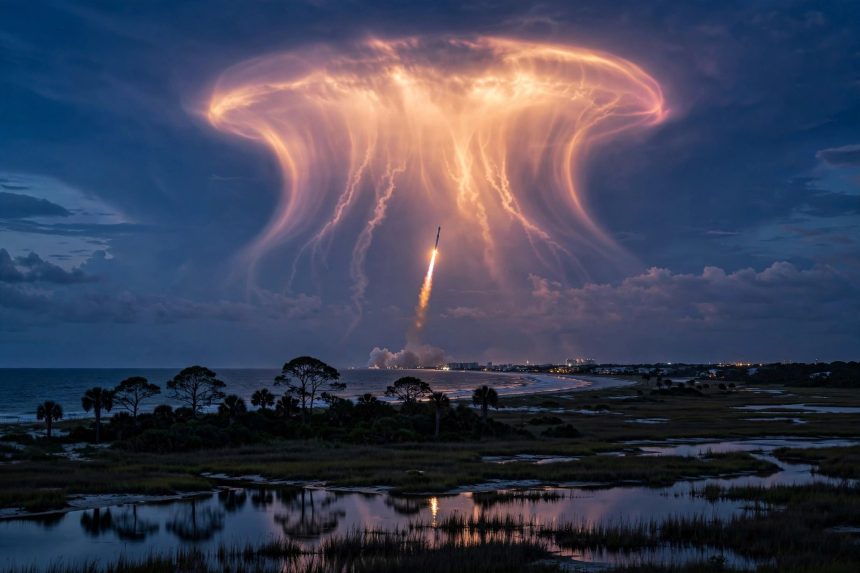
A routine evening launch turned into one of the most striking sky shows of the year this week, when a SpaceX rocket climbing through twilight created a glowing, jellyfish-shaped cloud that could be seen along much of the US East Coast. Photographs shared from beaches, highways and back gardens showed a luminous bloom high in a darkening sky, its pale tentacles trailing behind a bright central core as startled onlookers stopped to watch, film and wonder what they were seeing.
According to reporting by The Guardian, the display followed a SpaceX launch on 14 October and was visible off the east coast in the fading light after sunset. Within minutes, images of the strange formation were circulating widely online, with many viewers comparing it to a giant jellyfish drifting silently across the sky and others briefly wondering whether they had witnessed something far more mysterious.
A Twilight Phenomenon, Not a Mystery
Scientists have a straightforward, if beautiful, explanation. The effect is known as a twilight phenomenon, and it occurs when a rocket launches just before sunrise or just after sunset. On the ground, the sun has already dipped below the horizon and observers stand in darkness. High above them, however, the atmosphere is still in daylight. When the rocket reaches that sunlit layer, its exhaust plume catches the light and glows against the dark sky below.
As the plume expands in the thin upper atmosphere, where there is far less air pressure to contain it, the exhaust spreads out into a broad, billowing cloud. The shape is then sculpted by high-altitude winds, which stretch parts of the plume into long, curved streamers. The result, seen from hundreds of miles away, can look uncannily like a jellyfish: a bright, rounded head with translucent tendrils trailing behind it.
The colours add to the spectacle. Observers often describe whites, soft blues, pinks and faint orange tones in the cloud, caused by sunlight scattering through the exhaust and the upper atmosphere at a low angle. Because the plume is illuminated from a sun that is invisible to people on the ground, the whole formation can appear to glow from within, with no obvious source of light nearby.
Why the Cloud Can Be Seen So Far Away
Altitude is the key to the display’s reach. A rocket plume tens of miles above the Earth sits far above the horizon for viewers across a wide region, in much the same way that a tall mountain or a high-flying aircraft remains visible long after lower objects have faded into darkness. That is why reports and photographs of a single launch can arrive from several states at once, even though the rocket itself lifted off from one coastal launch site.
Timing matters just as much as height. Launches in the middle of the day produce exhaust that is difficult to see against a bright sky, while night launches may pass through air that is dark at every altitude. The jellyfish effect needs the narrow window in between, when the lower atmosphere is dark but the upper atmosphere is still sunlit. When conditions align, the contrast is dramatic and the cloud can linger, slowly expanding and drifting, for many minutes after the rocket has disappeared from view.
The phenomenon is not unique to SpaceX. Similar displays have followed launches by other operators in the United States, Russia, China and elsewhere for decades, and each generation of skywatchers tends to rediscover it with fresh astonishment. What has changed is the speed at which the moment is now shared. As our recent coverage explored in how digital publishers can make important stories easier to find and use, a striking image can travel around the world long before its explanation catches up.
A Busier Sky Brings More Sightings
Launches are far more frequent than they once were, driven by commercial satellite programmes, national space missions and a growing queue of payloads bound for orbit. SpaceX alone now launches at a cadence that would have been unthinkable a generation ago, placing batches of satellites, cargo and crew into space throughout the year. More twilight launches inevitably mean more chances for the geometry of sun, rocket and observer to line up.
For astronomers and space agencies, the displays are a reminder that activity in near-Earth space is increasingly visible to everyone, not only to specialists with telescopes. Bright satellite trains, re-entering debris and illuminated plumes have all prompted public questions in recent years, and officials often use moments like this one to explain what people are seeing and to distinguish ordinary launches from anything unusual.
For most witnesses, though, the science is only part of the appeal. The cloud’s brief, silent appearance turns an ordinary evening into an event shared by strangers across a coastline, all looking up at the same improbable shape. Readers can follow more science and space coverage on the World News Research homepage as launch schedules continue through the autumn.
As the plume faded and stars emerged, the jellyfish dissolved into darkness, leaving behind photographs, videos and a fresh round of questions for anyone who missed it. For those who did see it, the memory is likely to be simpler: for a few minutes, the evening sky contained something luminous and entirely out of place.