Continuous glucose monitors can help adults with type 2 diabetes who do not use insulin spend about five more hours each day with their blood sugar in a healthy target range, according to the largest clinical trial of its kind, published in the New England Journal of Medicine. The finding could significantly widen access to a technology that has transformed care for people with type 1 diabetes but has been offered far less routinely to the much larger type 2 population.
Researchers at the University of Colorado Anschutz led and reported the study, which tested whether round-the-clock glucose data could improve control for patients who manage their condition without insulin. Their summary of the results, published by the University of Colorado Anschutz, describes the improvement as approximately five additional hours per day spent in the target range, a change clinicians consider both substantial and meaningful in daily life.
What the Trial Found
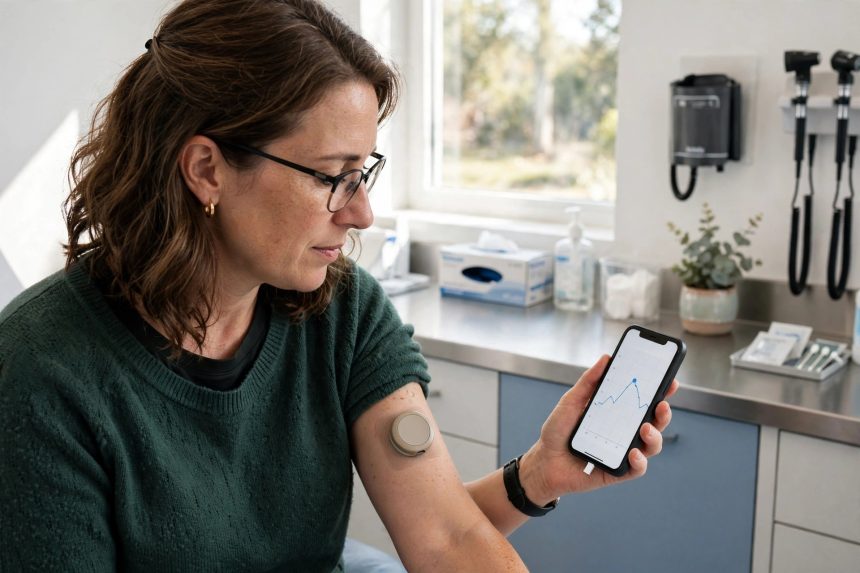
Continuous glucose monitors, often called CGMs, are small wearable sensors, usually worn on the arm or abdomen, that measure glucose in the fluid under the skin every few minutes. Instead of relying only on occasional finger-prick tests, users can see their current level, the direction it is moving and how meals, activity, stress and medication affect it throughout the day and night.
In the trial, that constant feedback translated into measurably better control. Spending more time in range is not simply a satisfying number on a screen. Clinicians use the measure because sustained periods above target contribute, over years, to the complications of diabetes, including damage to the eyes, kidneys, nerves and cardiovascular system. Five extra hours a day in range, compounded across months and years, represents a significant reduction in the time the body spends under that strain.
The scale of the study is part of its importance. Large, rigorous trials in this specific group, people with type 2 diabetes who are not on insulin, have been limited, and that evidence gap has been one reason insurers and health systems have been slower to cover the devices for them. A landmark trial published in one of the world’s most influential medical journals gives guideline committees and payers stronger data to weigh.
Why People Without Insulin Were Studied
Type 2 diabetes is by far the most common form of the condition, and many patients manage it with lifestyle changes and oral or other non-insulin medicines. Because they do not dose insulin around meals, they have traditionally been given fewer tools for monitoring, sometimes checking glucose only occasionally or not at all. Yet their blood sugar still rises and falls, and without feedback it can be difficult to know which habits are helping and which are quietly doing harm.
CGMs appear to work in this group partly as a learning tool. Seeing a glucose spike after a particular meal, or a steadier line after a short walk, gives immediate, personal evidence that abstract dietary advice cannot. Researchers and clinicians say that kind of feedback can motivate changes that stick, because patients are responding to their own data rather than to a general instruction. The device, in effect, turns every meal and every walk into a small experiment with a visible result.
That theme, making reliable information easier for people to act on, runs through much current health and technology reporting, including our coverage of how digital publishers can make important stories easier to find and use. In diabetes care, the principle is the same: information only improves outcomes when it reaches people in a form they can understand and use every day.
What It Could Mean for Patients and Coverage
The practical question now is access. CGM sensors are replaced regularly and costs can be significant without insurance coverage, which has historically concentrated use among people with type 1 diabetes and those with type 2 who use insulin. If coverage expands in response to this evidence, far more patients could be offered monitors, and primary care doctors, not only specialists, would likely play a larger role in prescribing and supporting them.
Clinicians caution that a monitor is not a treatment by itself. The data must be paired with guidance on interpreting trends, adjusting diet and activity, and reviewing medicines with a care team. They also note that individual responses vary, and that wearing a sensor involves practical considerations, from skin irritation to the risk of becoming anxious about every fluctuation. Time in range is a powerful measure, but it is one part of a broader picture that includes overall glucose levels, other health conditions and quality of life.
Even with those caveats, specialists say the direction of the evidence is clear and encouraging. For a condition that affects hundreds of millions of people worldwide, an intervention that adds hours of healthy control each day, without requiring insulin, is a notable step. Patients interested in whether a monitor might help them are advised to discuss the trial and their own situation with their doctor rather than buying devices without guidance. More health research coverage is available on the World News Research homepage.
As the researchers put it, the goal is not simply more data, but more of each day spent in a range that protects long-term health. On that measure, five hours is a striking gain, and one that may reshape how type 2 diabetes is monitored in the years ahead.