Enterprise data has grown dramatically in both scale and diversity, spanning structured databases as well as unstructured assets such as documents, emails, chat messages, and digital files. Legacy enterprise search tools—largely built on basic keyword matching—have struggled to keep up with this complexity. These systems depend on exact term matching, forcing users to guess the “right” keywords and manually filter through long lists of loosely related results. As a result, they often miss intent, lack contextual understanding, and deliver shallow outcomes that fail to meet modern expectations.
AI-driven enterprise search overcomes these limitations by shifting from keyword dependency to semantic understanding. Using natural language processing (NLP), modern search systems interpret both user queries and content at a conceptual level. Semantic search techniques represent text as dense vector embeddings that capture meaning rather than literal terms. This allows the system to surface relevant information even when phrasing differs, recognizing synonyms, related ideas, and underlying intent. Additionally, modern enterprise search platforms can continuously ingest and reflect real-time updates from knowledge repositories, rather than relying on static indexes. The result is a far more intelligent discovery experience—one that delivers precise answers and actionable insights instead of a disconnected list of keyword matches.
Alongside these advances, Retrieval-Augmented Generation (RAG) has emerged as a transformative approach to enterprise search. RAG combines information retrieval with generative AI, enabling systems to produce direct answers or summaries grounded in retrieved enterprise content rather than simply pointing users to documents. This ensures that even across vast and dynamic datasets, users receive timely, relevant, and context-aware responses. By anchoring generative models in enterprise data, RAG addresses the shortcomings of traditional keyword search, supports complex and domain-specific queries, and provides traceable, source-based reasoning. The shift from keyword search to RAG-powered semantic search represents a major leap in enterprise knowledge discovery, aligning results with true information needs rather than surface-level text matches.
ZBrain positions itself as a unified, end-to-end AI enablement platform designed to support the development of tailored AI solutions for enterprise environments. Central to its intelligent search capability is graph-based RAG, which brings together three complementary components:
- Knowledge graph models that represent data as nodes and edges, capturing semantic relationships
- Vector databases that enable fast similarity searches across high-dimensional embeddings
- Semantic search techniques that interpret user intent and retrieve the most relevant information
By integrating graph-based retrieval with generative models, ZBrain delivers a search and discovery experience that goes well beyond keyword matching or flat vector retrieval, enabling deeper insights and more accurate answers.
Understanding the RAG approach in ZBrain
Retrieval-Augmented Generation is an advanced NLP framework that enhances large language models (LLMs) by introducing an external retrieval step. While LLMs excel at language generation, they rely on static training data and can produce inaccurate or hallucinated responses. RAG mitigates these limitations by dynamically retrieving relevant enterprise knowledge at query time.
In a typical RAG pipeline, the process begins with retrieval. When a user submits a query, the system searches enterprise knowledge sources—such as document repositories, intranets, or databases—using dense embeddings and similarity search techniques. The retrieved content is then supplied to an LLM, which generates a final response grounded in real, authoritative data. This effectively gives the model access to a “non-parametric memory,” allowing it to reference up-to-date enterprise knowledge rather than relying solely on its fixed, pre-trained memory.
This approach delivers several key benefits:
- Accurate and current responses: Answers are based on the latest retrieved data rather than static training knowledge.
- Domain-specific relevance: Company-specific documents, policies, and reports ensure outputs align with organizational context.
- Reduced hallucinations: Grounding responses in retrieved source material significantly lowers the risk of fabricated or unverifiable information.
ZBrain’s graph RAG: Smarter and more dependable knowledge retrieval
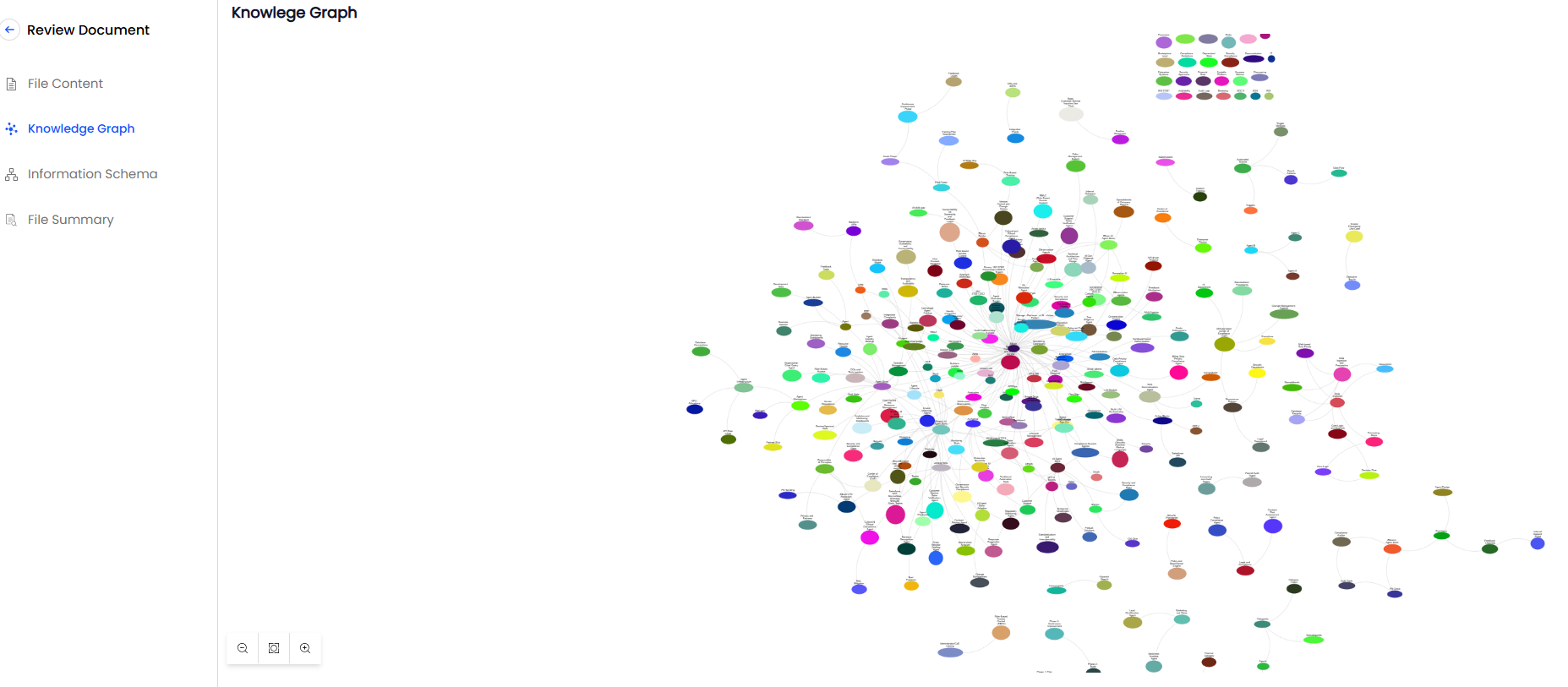
Graph RAG represents an evolution of standard RAG by incorporating an explicit knowledge graph built from the document corpus. Instead of relying only on vector similarity, graph RAG extracts entities and their relationships to create a structured semantic graph. During indexing, documents are broken into analyzable units, entities and connections are identified, and related nodes are grouped into hierarchical clusters or “communities.” These communities are summarized—often using an LLM—providing a high-level view of the data alongside granular details.
Graph RAG follows a modular pipeline aligned with traditional RAG stages, but with the graph at its core:
- Indexing and graph construction: Entities and relationships are identified and organized into a structured graph. Nodes are clustered into communities, each summarized to represent overarching themes.
- Graph-based retrieval: Queries are resolved through graph operations rather than simple vector lookup. This may involve linking query terms to entities and traversing relationships to retrieve relevant subgraphs, enabling the system to connect information spread across multiple documents.
- Context injection and prompting: Retrieved nodes or community summaries are injected into the LLM prompt. Broad questions may leverage high-level summaries, while specific queries draw on neighboring nodes and associated text, ensuring the LLM receives focused, relevant context.
Retrieval efficiency and query adaptability
Graph RAG naturally handles complex retrieval scenarios that challenge traditional approaches. Multi-hop questions—such as identifying relationships between entities—are resolved through graph traversal rather than relying on a single document containing all relevant facts. ZBrain supports multiple retrieval modes:
- Global search: Uses community summaries to answer high-level or exploratory questions.
- Local search: Starts from a specific entity and expands outward to gather closely related information.
- Hybrid (DRIFT) search: Combines local entity details with broader community context to balance precision and completeness.
These modes adapt automatically based on query complexity. Broad questions trigger summary-driven retrieval, while targeted questions rely on localized graph exploration. Because relationships are explicitly encoded, the system can surface relevant connections even when query language differs from source text.
From an efficiency standpoint, graph RAG is highly economical. Summarizing document clusters and retrieving only relevant nodes dramatically reduces the number of tokens passed to the LLM. Industry benchmarks show that graph-based RAG can cut token usage by 26–97% compared to conventional RAG, while significantly improving accuracy. The knowledge graph effectively filters and routes information, delivering richer context with minimal computational overhead.
Enterprise integration and real-world impact
Once relevant graph-derived knowledge is retrieved, it is injected into the LLM prompt to guide generation. Community summaries provide background context, while individual nodes supply precise facts. This structured prompting keeps responses focused, accurate, and logically grounded. Because the pipeline is modular, organizations can independently tune components—such as graph databases, embedding models, or summarization engines—without reengineering the entire system.
In enterprise environments, where data is highly interconnected, this graph-centric approach delivers substantial advantages. Knowledge graphs naturally represent relationships between teams, projects, policies, and systems, enabling queries that span multiple domains. Graph RAG also supports adaptive retrieval strategies: simple questions may rely on summaries, while complex compliance or technical queries traverse multiple graph paths. Over time, feedback signals can further refine graph relevance and rankings.
By embedding retrieval and ranking logic directly into the knowledge graph, graph RAG eliminates many limitations of flat RAG architectures. Explicit relationships remove the need for heavy re-ranking, while cluster summaries prevent information overload. The result is consistently precise, context-aware answers that significantly improve operational efficiency.
ZBrain’s enterprise search pipeline with graph RAG
ZBrain’s enterprise search pipeline is a comprehensive ETL and retrieval framework built for internal knowledge systems.
Data ingestion:
Data is ingested from a wide range of sources—including Jira, Confluence, Slack, databases, cloud storage, and web content—via modular connectors. A Django-based microservice manages scheduled and on-demand extraction, supporting parallel ingestion and streaming sources such as Kafka and webhooks. All connections are secured, data is encrypted at rest, and access is governed by role-based controls.
Data chunking and preprocessing:
Raw content is cleaned, normalized, and divided into semantically meaningful chunks aligned with embedding model limits. Each chunk is enriched with metadata such as source, author, and timestamps. ZBrain supports both automatic and custom chunking strategies, ensuring optimal semantic representation across diverse document types.
Embedding generation and storage:
Chunks are embedded using interchangeable, state-of-the-art models, allowing organizations to balance semantic richness with performance. Embeddings are stored in vector databases for fast similarity search, while raw files and metadata are retained in object and metadata stores, enabling a layered knowledge architecture.
Retrieval strategies:
ZBrain supports semantic vector search, lexical keyword search, hybrid retrieval, and graph-based RAG. Simpler or exploratory queries rely on vectors, while complex, relationship-driven questions invoke graph traversal for deeper reasoning.
Knowledge graph construction:
Entities and relationships are extracted using NLP and organized into a structured knowledge graph. Nodes and edges inherit metadata and access controls, enabling policy-aware and role-aware retrieval. The graph enables multi-source reasoning, connecting facts that flat search would overlook.
Graph RAG for advanced reasoning and governance
Graph RAG enables multi-hop reasoning, policy-aware responses, improved accuracy, and explainability. By grounding generation in structured relationships, it ensures outputs align with organizational rules and permissions. Studies show significant gains in answer accuracy, reduced token usage, and faster resolution times across enterprise workflows.
Endnote
As organizations contend with expanding volumes of complex, siloed data, ZBrain’s graph RAG–powered enterprise search delivers a clear strategic advantage. By combining semantic preprocessing, flexible embeddings, hybrid retrieval, and a structured knowledge graph, ZBrain ensures every query is answered with accuracy, context, and speed.
More than a technical upgrade, graph RAG transforms enterprise AI into a strategic capability—driving better decisions, faster insights, lower operational costs, and stronger governance. For enterprises seeking scalable, secure, and future-ready knowledge intelligence, ZBrain’s graph RAG framework offers a powerful and sustainable path forward.