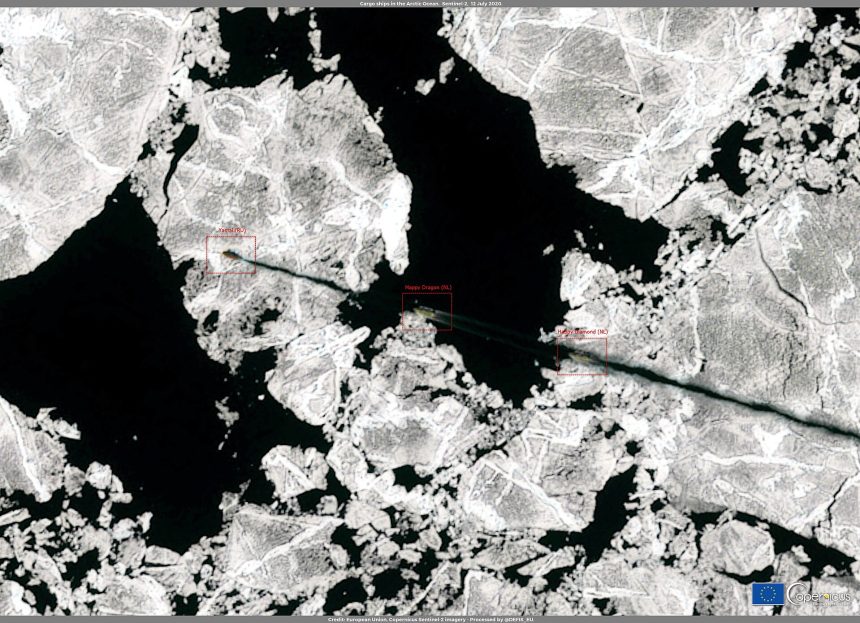
The Northern Sea Route along Russia’s coast cuts the voyage from Shanghai to Rotterdam by roughly two weeks compared with Suez; the Northwest Passage through Canada’s archipelago promises the same for North America. For most of history these were expedition routes. With Arctic sea ice retreating — the region warms several times faster than the global average, as assessments by NOAA‘s annual Arctic Report Card document — they are becoming seasonal commercial corridors, and the world’s shipping, insurance and naval planners are recalculating accordingly.
Traffic remains modest by Suez standards: dozens of transits a season rather than tens of thousands, dominated by Russian resource exports — liquefied natural gas and oil from Arctic fields — moving in ice-class tankers, increasingly eastward to Asia. Container lines have tested the route and mostly retreated, citing unpredictability: a shortcut that saves twelve days in a good September can cost them in an icy October, and liner shipping runs on promises. Insurers price the gaps honestly — sparse charts, distant salvage, ports of refuge measured in days — while environmental groups catalogue what an oil spill in ice would mean for ecosystems with no realistic cleanup. The International Maritime Organization‘s Polar Code sets the safety baseline everyone argues from.
The Strategic Layer
Under the commerce runs the chess game. Russia treats the route as sovereign infrastructure, requiring permissions and offering icebreaker escorts for fees; China describes itself as a “near-Arctic state” and folds the passage into its Polar Silk Road planning; Canada and the United States dispute the legal status of the Northwest Passage between them while jointly watching everyone else. Coast guards, icebreakers and Arctic bases are being funded like the map matters again — because it does. Our world desk tracks the region in our world coverage.
A Route Being Born Slowly
The Icebreaker Gap
Every Arctic ambition runs aground on the same unglamorous asset: icebreakers. Escorting convoys, breaking rescue paths and asserting presence all require hulls that take a decade to build, and the fleets are lopsided — Russia operates dozens, including nuclear-powered giants; the United States has been racing to rebuild a fleet that dwindled to a handful of ageing vessels; China, with no Arctic coastline, has launched icebreakers as instruments of intent. Shipbuilding programmes now underway on several continents will define the region’s practical map more than any declaration: a route is real when someone can reliably keep it open and answer a distress call on it. The Arctic’s future will be written less in summit communiqués than in shipyards, by the countries willing to pay for steel that works at forty below.
For the peoples who actually live on those coasts, the shipping debate is not abstract. Inuit and other Indigenous organisations across the circumpolar north have asserted — increasingly with legal effect — that the new routes cross their waters, hunting grounds and governance, and that no traffic regime is legitimate without their consent and benefit. Their demands are practical: routing away from hunting areas, speed limits that protect marine mammals, search-and-rescue capacity that a spill or a grounding would test within hours rather than days, and a share of the economic value the shortcut creates. The smart shipping states are learning to negotiate rather than notify. The Arctic’s oldest inhabitants intend to be its newest routes’ landlords, not their scenery.
The sober consensus is that the Arctic becomes a serious trade artery gradually, resource exports first, scheduled container services last — a seasonal supplement to Suez and Panama, not their replacement, for decades. But gradual is not negligible. A corridor that exists even three months a year changes insurance tables, naval postures and the bargaining power of every chokepoint it bypasses. The ice is opening a door the world’s maps were not drawn for, and everyone with a coastline is quietly re-drawing theirs.