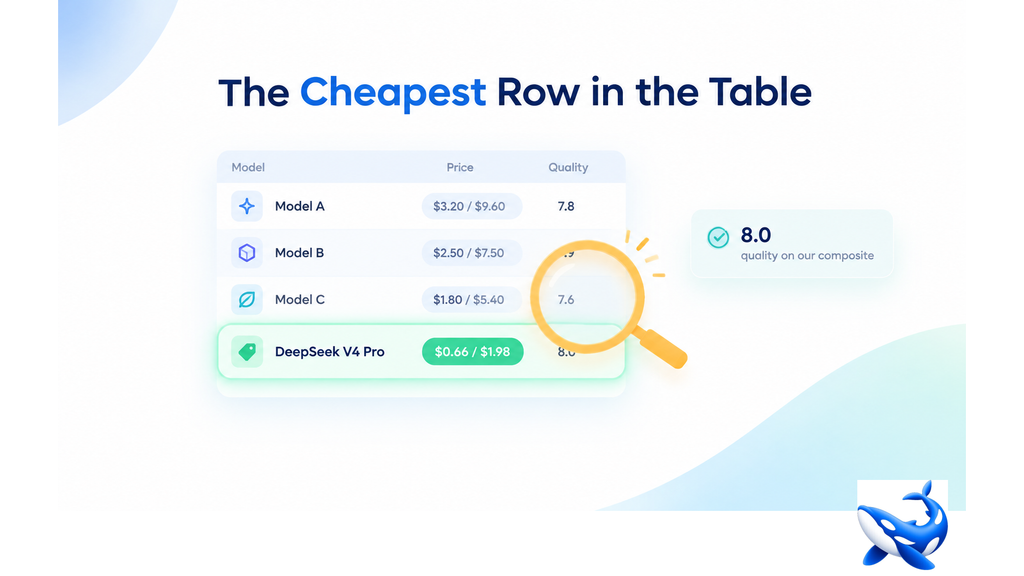
The bottom of the price column is not automatically a trap, and the $0.66 row proves it. On OrcaRouter the llm comparison page lists DeepSeek V4 Pro at $0.66 per million input tokens and $1.98 per million output — the cheapest full-sized row in the table — and next to that price it carries an 8.0 quality score on our composite, the score we build ourselves by grading each model across our own quality dimensions. The same 8.0 that this row earns is earned by two other cheap rows on the same page.
Cheap is not the same thing as bad, and on this table the bottom of the price column is not the bottom of the quality column. That split is the whole story of the row.
What the cheapest full-sized row actually is
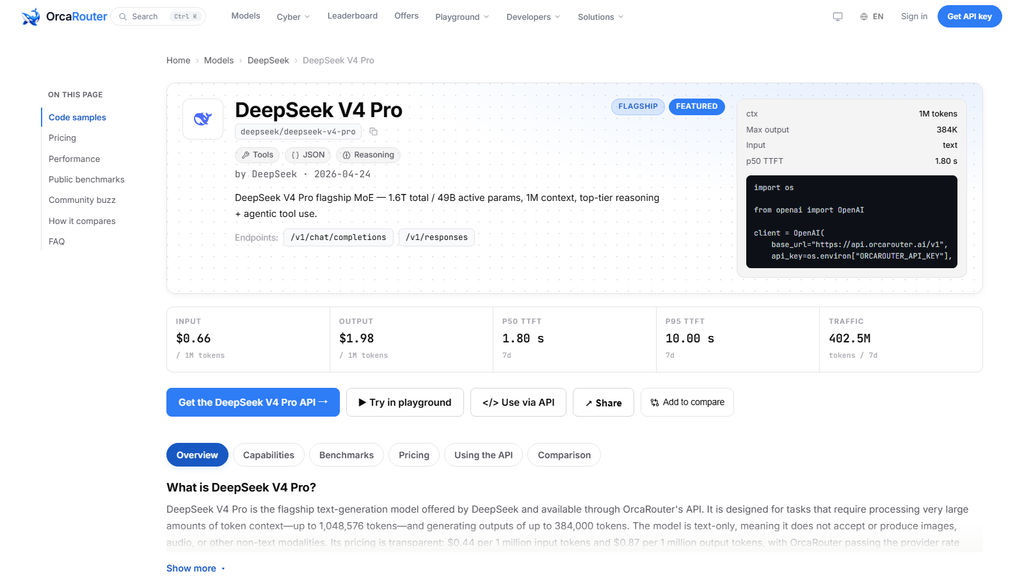
DeepSeek V4 Pro is the least expensive full-sized model in the comparison table. Its input price of $0.66 per million tokens is a hair above MiniMax M2.7 highspeed’s $0.60, but MiniMax is a specialty card — a fast, small row with a 205-thousand-token context window that does not pretend to compete on every job. Among the rows that carry a full one-million-token window and a general-purpose remit, DeepSeek V4 Pro is the bottom of the price column, and it stays there on output too, at $1.98 per million tokens, with a 3.0-times output multiplier, the lowest on the page.
It is not cheap because it is broken. On our quality composite it scores an 8.0 out of 10, and 8.0 is not a grudging number: it is the same score posted by kimi-k2.6, which costs $0.95 per million input and $4.00 per million output, and by MiniMax M2.7 highspeed at $0.60 and $2.40 — the three cheapest rows in the table all land on the same 8.0, while rows priced far higher do not beat them on that column. The premium tiers of the table sit above them, but the 8.0 tier is a real tier, not a consolation prize. And the score is deliberate: it is our own composite, built by grading each model across our own quality dimensions, never a third-party benchmark, so when we put a row at 8.0 we are describing the exact dimensions we grade, not a borrowed ranking.
Reading the row’s other columns
The cheap row is not cheap everywhere. Its one-million-token context window matches the field’s best, so the jobs that need a long document in a single request are not automatically closed to it. Its latency is among the best on the page: a 1.76-second p50 time-to-first-token in our production telemetry is the quickest full-sized reading in the table, comfortably ahead of the premium rows, several of which sit pinned at the 10.00 second ceiling — the measurement ceiling, not a genuine latency, which is why the same value appears across most of the table. And the market has noticed: over the trailing seven days the row has carried 512.0 million tokens of production traffic on our side, the busiest row in the entire table, against 42.8 million for the $2-per-million Gemini 3.1 Pro Preview and 101.8 thousand for the $30-per-million GPT-5.5 Pro. A million tokens is a unit of trust; 512 million is a lot of trust.
None of that makes it the right row for everything, and the column that says so is the quality column. 8.0 is below the table’s top tier — Gemini 3.1 Pro Preview and Claude Fable 5.1 both score a perfect 10.0 — and for a workload that leans on the hardest reasoning, the price gap narrows and the quality gap widens until the cheap row stops being the cheap answer and starts being the wrong answer. The cheap row is not a promise of perfection; it is a promise of the most quality per dollar that the table offers, which is a different promise entirely.
What the other two 8.0 rows add
The interesting thing about the 8.0 tier is that it is not homogeneous either. The three rows that share the score differ in ways the composite cannot show. kimi-k2.6, at $0.95 in and $4.00 out, carries the smallest context window of the three at 262 thousand tokens and the highest output multiplier of the tier at 4.2 times. MiniMax M2.7 highspeed, at $0.60 in and $2.40 out, has the thinnest window at 205 thousand, the fastest p50 in the whole table at 3.29 seconds, and nearly no traffic at all — 3.2 thousand tokens in seven days, a row the market has not yet adopted. DeepSeek V4 Pro threads the middle: the largest window of the tier, the best output price, and by far the most traffic. When three rows share a quality digit, the columns that separate them are the ones doing the real comparing. The point is that an 8.0 is a level, not a lockstep: the three rows are different enough that picking among them still requires the price column, the context column and the latency column, which is exactly why the comparison page prints all of them.
Where the cheap row is the right answer
The honest way to buy a cheap row is to know the jobs it does well and the jobs it does not. DeepSeek V4 Pro is the right answer for the traffic that actually dominates production AI today: high-volume, cost-sensitive, ordinary-request work — the summarization, classification, extraction, and routing that make up the bulk of real bills. For that traffic, 8.0 quality on our composite against a $0.66 input price and a $1.98 output price is the best value per unit of capability on the page, and the market’s 512.0 million tokens of weekly volume is the strongest available confirmation that the arithmetic holds at scale.
The row is the wrong answer for a narrower set of jobs. A workload that pushes a model to its reasoning limit — the long, one-shot, high-stakes call where a 10.0 model earns its $10-per-million input price — will not be saved by the cheap row, and pretending otherwise is how teams save $0.66 per million and spend weeks fixing the output. The quality column exists to keep that boundary visible: it is our own composite, not a third-party benchmark, and 8.0 is its way of saying “most jobs, most of the time” rather than “every job, always.”
The takeaway
DeepSeek V4 Pro is the cheapest full-sized row in the table at $0.66 per million input tokens and $1.98 per million output, and cheap does not mean broken: it scores 8.0 on our quality composite — the same score earned by kimi-k2.6 at $0.95 and $4.00 and MiniMax M2.7 highspeed at $0.60 and $2.40 — it posts the fastest full-sized time-to-first-token on the page at a 1.76-second p50, and it has carried 512.0 million tokens of seven-day traffic, more than any other row.
The cheapest row in the table is worth it for exactly the traffic that dominates production AI: high-volume, cost-sensitive, ordinary work where 8.0 quality at that price is the best value on the page. Keep the premium rows for the narrow jobs that genuinely need them, and let the quality column — our composite, graded by us, never a third-party benchmark — draw the line between the two.
Sourcing note: all prices, multipliers, context windows, p50 time-to-first-token figures, composite quality scores and seven-day token volumes are OrcaRouter production data from the comparison page and the linked model page, read 2026-10-12. Composite quality scores are our own, built by grading each model across our own quality dimensions; they are not a third-party benchmark. Latency and volume figures are rolling telemetry that will drift, and the 10.00 s value is the measurement ceiling. All checked 2026-10-12.