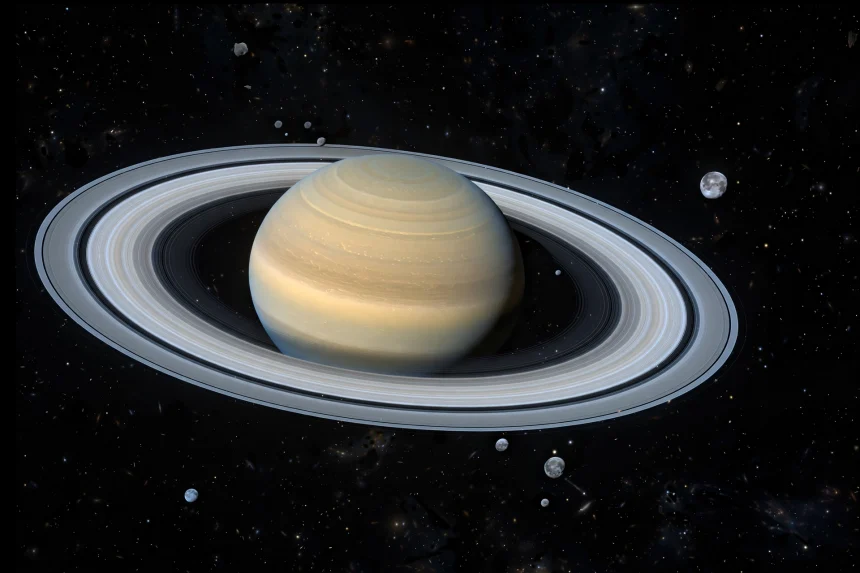
Saturn has pulled far ahead of every other planet in the solar system. Astronomers have confirmed 128 additional moons around the ringed planet, raising its recognised total from 146 to 274. That is more moons than all the other planets combined, a striking result that says as much about patient research as it does about Saturn itself. The confirmations were recognised by the International Astronomical Union, the body responsible for formally naming and cataloguing such objects.
How a research team built the case
The work rested on years of deep imaging from the Canada-France-Hawaii Telescope on Mauna Kea in Hawaii. Rather than spotting bright objects in single exposures, the researchers returned to the same fields again and again, building a record that could separate genuine companions of Saturn from background stars and distant asteroids. Members of the team included researchers from the University of British Columbia, among them Dr Edward Ashton, whose group has specialised in searching the dark outskirts of the giant planets. Their findings are summarised by the University of British Columbia for readers who want the institutional background.
Confirmation in astronomy is rarely a single dramatic moment. A candidate object must be followed long enough for its orbit to be calculated, checked against earlier observations and shown to move with Saturn rather than past it. Only then does a provisional detection become a counted moon. That slow, careful process explains why so many objects were announced together: the evidence for the whole group matured at roughly the same time, after seasons of observation and analysis were finally combined and reviewed.
Tiny, tilted and travelling backwards
None of the newcomers resembles Earth’s large, round Moon. Most are only a few kilometres across, irregular in shape and far from the planet. Their orbits are tilted at steep angles, stretched into long loops, and in many cases retrograde, meaning they travel around Saturn in the opposite direction to the planet’s rotation and to its familiar inner moons. From Earth they are little more than faint points of reflected sunlight, close to the limit of what even a large telescope can record reliably.
Those odd orbits are a clue to their origin. Astronomers believe many of these small bodies were not born beside Saturn at all. Instead, they were probably captured long ago, drawn in by the planet’s gravity as they wandered through the early solar system. Later collisions appear to have shattered some larger captured moons into families of fragments, which still follow broadly similar paths today. Grouping the fragments by orbit therefore lets researchers reconstruct breakups that may have happened millions or even billions of years ago.
Why the count matters for science
A larger catalogue is not just a record for its own sake. Each new moon is a data point about how giant planets grow, how they capture material and how violent the young solar system really was. If Saturn holds this many small companions, similar swarms may surround the other giant planets, simply waiting for instruments patient enough to find them. The result also sharpens comparisons between planets: Jupiter, long Saturn’s rival in moon counts, now trails by a wide margin that will be difficult to close.
For readers following space coverage here, our earlier report on a SpaceX launch that painted a jellyfish-shaped cloud over the East Coast showed the more visible side of the night sky. This discovery is the opposite kind of story: nothing flashed or streaked overhead. Progress came from archived pixels, repeated measurements and researchers willing to argue, object by object, that a faint smudge deserved a place in the official record.
What happens next
The newly confirmed moons will now receive formal designations, and follow-up observations will refine their orbits further. Some groupings may be reinterpreted as more data arrives, and still fainter candidates are likely sitting in existing survey images, not yet tracked long enough for confirmation. Saturn’s total of 274 should therefore be read as a well-evidenced floor, not a final ceiling. The research message is clear: around the giant planets, the map is still being drawn, and the smallest objects on it may carry some of the oldest stories in the solar system.