A personalised cancer vaccine called NeoVax could be manufactured for individual patients and given alongside the immunotherapy drug nivolumab, according to a phase 1 study in platinum-sensitive recurrent ovarian cancer published in Nature Medicine. The researchers’ conclusion was deliberately narrow: the approach was feasible, its safety profile was acceptable in this small group, and immune responses were detected. It was not presented as proof that the vaccine improves survival, and readers should hold on to that distinction throughout this report.
A vaccine built from one patient’s tumour
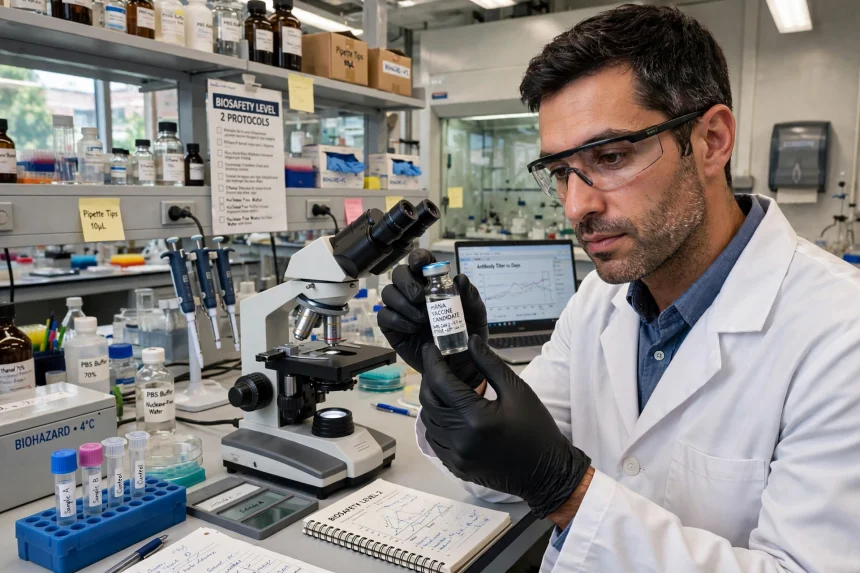
NeoVax is not a single product pulled from a shelf. For each participant, scientists examined the mutations in that person’s tumour and selected neoantigens, abnormal protein fragments produced by the cancer and largely absent from healthy tissue. A vaccine was then made to present those targets to the immune system, in effect handing T cells a set of identifying features to search for. The study is described by the journal Nature Medicine, where the peer-reviewed paper appeared, and background on ovarian cancer is available from the National Cancer Institute.
Pairing the vaccine with nivolumab has a clear logic. Nivolumab blocks PD-1, a checkpoint that can restrain T cells, so the combination aims first to teach the immune system what to recognise and then to reduce one of the brakes that might stop it acting. Ovarian cancer that returns after platinum-based treatment remains difficult to manage, which is why even early, carefully framed studies in this setting attract attention from researchers and patients alike.
What a phase 1 trial is designed to answer
Phase 1 studies are primarily about whether something can be done safely enough to study further. In this case the manufacturing question mattered as much as the medical one: could tumour material be analysed, a personalised vaccine produced, quality checks completed and doses delivered to the patients for whom they were made, within a clinically workable process? The investigators reported that this chain held together. They also reported that treatment was tolerable enough to be described as having an acceptable safety profile, the standard early-trial judgement rather than a guarantee for wider use.
The immune findings were the other encouraging signal. Researchers observed T-cell responses linked to the vaccine approach, suggesting the immune system could register the neoantigen targets it was shown. That is a meaningful biological result, because a vaccine that produces no measurable response would have little reason to advance. Yet a laboratory response is not the same as shrinking tumours or extending life, and this study was neither large enough nor designed to settle those questions.
Why restraint matters in reporting
Our health coverage tries to separate possibility from proof, a theme also visible in our earlier explainer on continuous glucose monitors tested in type 2 diabetes, where device data still needed careful interpretation. The same discipline applies here. Participants had a specific form of recurrent disease, described as platinum-sensitive, so the findings cannot simply be transferred to every person with ovarian cancer. The group was small, there was no large comparison arm, and personalised manufacturing is complex and resource intensive.
The questions larger studies must answer
Next, researchers would need bigger trials that can test whether adding NeoVax changes outcomes that matter to patients, such as how long disease is controlled and overall survival, and whether any benefit justifies the cost and logistics of bespoke production. Better selection may also matter: identifying whose tumours produce strong neoantigen targets, and whose immune systems respond most, could shape future designs. For now, the honest summary is modest but real. A personalised vaccine strategy was built, delivered with nivolumab, tolerated acceptably in an early study and associated with immune responses. That is a foundation for further research, not a finished treatment story.
A note on personalised production
Personalised production also raises a research question that rarely appears in headlines: consistency. Two vaccines made for two different patients are not the same product, yet the process behind them must be consistent enough for regulators and clinicians to trust. Every step, from tumour sampling to target selection and final release, has to be documented in a way that another laboratory could audit. That discipline is part of what feasibility means in practice. A trial that can show a repeatable process, as well as individual immune responses, gives the next research team something solid to build on rather than a one-off technical achievement.