Protein transfection reagents have become indispensable tools in modern cell biology, biochemistry, and therapeutic research. Unlike traditional DNA or RNA transfection methods that rely on cellular transcription or translation machinery, protein transfection reagents enable the direct introduction of fully folded, functional proteins into the cytoplasm or nucleus of living cells. This approach bypasses the need for gene expression, offering immediate biological effects and allowing researchers to study protein function, localization, signaling pathways, and therapeutic delivery with high temporal precision.
As of late 2025, the field of protein delivery continues to advance rapidly, driven by applications in CRISPR base editing, intracellular antibody delivery, enzyme replacement therapies, and high-throughput screening of protein variants. Recombinant protein transfection reagents, in particular, provide reproducible, high-efficiency delivery with minimal cytotoxicity, making them a preferred choice for both academic labs and biopharmaceutical development pipelines.
This article explores the principles, mechanisms, key advantages, common applications, and practical considerations when selecting and using protein transfection reagent in contemporary research.
The Challenge of Direct Protein Delivery
Proteins are large, charged macromolecules that cannot passively cross the plasma membrane due to their size and physicochemical properties. Early attempts at protein delivery relied on invasive methods (microinjection, electroporation) or crude carriers (liposomes, cell-penetrating peptides), which suffered from low efficiency, high toxicity, poor reproducibility, or limited cell-type compatibility.
Modern protein transfection reagents overcome these limitations by encapsulating or complexing recombinant proteins into nanoscale delivery vehicles that facilitate endosomal uptake followed by cytosolic release. The goal is to achieve high intracellular bioavailability while preserving protein folding, activity, and post-translational modifications.
How Protein Transfection Reagents Work
Most commercially available recombinant protein transfection reagents rely on cationic lipid or polymer-based nanoparticle formation. The general mechanism involves the following steps:
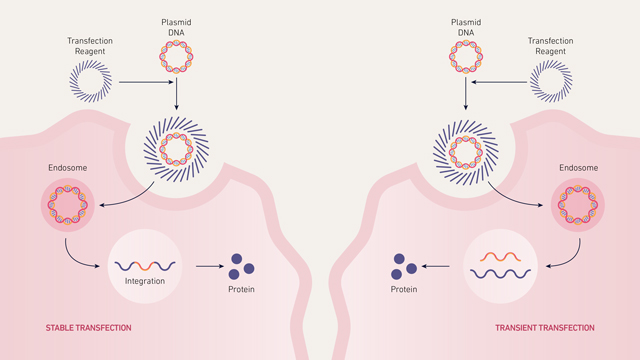
- Complexation: The reagent, typically a cationic lipid or polymer, electrostatically binds to the negatively charged regions of the target protein, forming nanoscale complexes (often 100–300 nm in diameter).
- Cellular uptake: These complexes interact with the negatively charged cell membrane and are internalized primarily via endocytosis (clathrin-mediated or caveolae-mediated pathways).
- Endosomal escape: Once inside the endosome, the reagent induces membrane destabilization or osmotic swelling (via the proton sponge effect in the case of polymers), allowing the protein to escape into the cytosol before lysosomal degradation occurs.
- Intracellular release: The released protein becomes biologically active, enabling immediate functional studies or therapeutic effects.
Advanced formulations may incorporate endosomal disruptors, fusogenic lipids, or pH-sensitive components to further enhance cytosolic delivery efficiency.
Key Advantages of Using Recombinant Protein Transfection Reagents
Recombinant protein transfection reagents offer several decisive advantages over nucleic acid-based methods:
- Immediate biological activity — no transcription or translation lag time; effects are observable within minutes to hours.
- Precise control over protein concentration and timing — researchers can deliver exact amounts of active protein without variability introduced by gene expression levels.
- Delivery of native, post-translationally modified proteins — ideal for studying proteins that require specific folding, glycosylation, or phosphorylation states.
- Lower risk of genomic integration or off-target effects — unlike plasmid or viral delivery, there is no risk of permanent genetic alteration.
- Compatibility with difficult-to-transfect cells — many reagents perform well in primary cells, stem cells, and hard-to-transfect lines where DNA transfection efficiency is low.
These properties make protein transfection reagents particularly valuable for functional genomics, drug target validation, intracellular signaling studies, and emerging protein-based therapeutics.
Common Applications of Protein Transfection Reagents
Protein transfection reagents are widely used across multiple research and preclinical domains:
- Functional validation of recombinant proteins (e.g., enzymes, transcription factors, antibodies)
- Intracellular delivery of CRISPR-Cas proteins for base editing or gene silencing without DNA templates
- Delivery of therapeutic proteins (e.g., antibodies, cytokines, growth factors) into target cells
- High-throughput screening of protein variants or mutant libraries
- Study of post-translational modification effects by delivering modified vs. unmodified proteins
- Investigation of protein-protein interactions or subcellular localization in live cells
- Development of protein-based cell therapies or regenerative medicine approaches
In many cases, protein transfection provides cleaner, faster answers than overexpression studies, especially when transient effects or precise stoichiometry are required.
Choosing the Right Protein Transfection Reagent
Selecting an appropriate reagent depends on several factors:
- Cell type compatibility — some reagents perform better in adherent vs. suspension cells or primary vs. immortalized lines.
- Protein properties — molecular weight, isoelectric point, surface charge, and stability influence complexation efficiency.
- Desired intracellular destination — cytosolic vs. nuclear delivery may require different formulations.
- Toxicity profile — critical for sensitive cells (primary neurons, stem cells).
- Efficiency vs. cell viability trade-off — higher delivery rates sometimes correlate with increased cytotoxicity.
- Cost and scalability — important for high-throughput screening or preclinical studies.
Most commercial reagents are optimized for a broad range of proteins and cell types, but pilot experiments are recommended to determine the optimal reagent, dose, and incubation conditions for your specific application.
Best Practices for Successful Protein Transfection Experiments
Achieving reproducible, high-efficiency protein delivery requires careful optimization:
- Use high-purity, correctly folded recombinant proteins (avoid aggregates or denatured preparations).
- Prepare fresh complexes immediately before transfection; do not store pre-formed complexes.
- Optimize protein:reagent ratio — most protocols provide starting ratios, but titration is often necessary.
- Use serum-free medium during the transfection incubation to avoid interference from serum proteins.
- Remove transfection complexes after 4–6 hours and replace with complete growth medium.
- Include appropriate controls (untreated cells, reagent-only, protein-only) to distinguish specific effects from artifacts.
- Validate delivery using fluorescence microscopy (if the protein is labeled) or functional assays.
Monitoring cell viability (MTT, trypan blue, or flow cytometry) and confirming intracellular localization or activity are critical for interpreting results.
Limitations and Future Directions
While protein transfection reagents have advanced significantly, challenges remain. Delivery efficiency varies widely across cell types, and some proteins (highly charged, very large, or aggregation-prone) remain difficult to deliver. Endosomal entrapment and lysosomal degradation can reduce cytosolic bioavailability in certain cell lines.
Looking ahead, ongoing research focuses on next-generation carriers: peptide-based shuttles, virus-like particles, exosome-based delivery, and stimuli-responsive nanoparticles that improve endosomal escape and cell-type specificity. Advances in machine learning-guided design of transfection reagents and high-throughput screening of protein-reagent combinations are also accelerating progress.
Final Thoughts: The Growing Importance of Protein Transfection Reagents
As research increasingly shifts toward direct manipulation of protein function rather than gene expression, protein transfection reagents are becoming essential tools in the modern life science laboratory. Their ability to deliver native proteins rapidly, quantitatively, and with minimal perturbation makes them uniquely powerful for functional studies, target validation, and therapeutic development.
For any researcher working on intracellular protein dynamics, signaling pathways, or protein-based therapeutics, familiarity with available protein transfection reagents — and careful optimization of delivery conditions — can dramatically accelerate discovery and improve experimental reproducibility. In 2025 and beyond, these reagents are no longer niche tools; they are becoming standard equipment for cutting-edge cell biology and translational research.