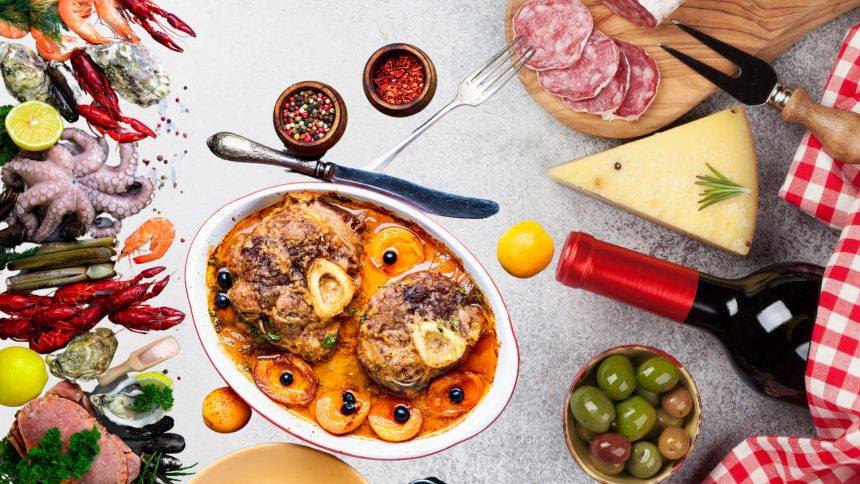
When people talk about Italian food, they often imagine a single national cuisine — pasta, pizza, olive oil, and red wine. But that image is incomplete. Italy is a country where every region, sometimes every town, has its own version of what “Italian food” means. The gap between north and south, mountain and coast, city and countryside, is wider than most realize. It’s a bit like how outcomes shift from one round to another in a big small betting game online: the structure looks simple, but the details change everything.
Geography Divides the Table
Italy’s landscape makes its cooking uneven. The north is cool and mountainous, with cows, butter, and rice. The south is hot and dry, with olive trees, tomatoes, and wheat. The coastline gives access to fish and salt; the inland hills depend on grains, beans, and pork. Geography limits what people can grow, but it also shapes taste.
In Lombardy and Piedmont, rice grows well, so risotto became the local dish. In Emilia-Romagna, pigs thrive and prosciutto, salami, and ragù define the region. Farther south, in Calabria and Sicily, hot peppers and preserved vegetables are part of daily cooking. Each area built its food habits around what it could rely on year after year. The result isn’t just regional recipes — it’s regional logic.
History Set the Rules
Before Italy became one country in the 19th century, it was a patchwork of city-states, kingdoms, and colonies. That long fragmentation mattered. Each region developed its own rulers, trade partners, and customs. Over centuries, those ties shaped what people ate.
Sicily absorbed ideas from Arab traders — sugar, almonds, and citrus. Naples took influence from Spain and later from the Americas with the tomato. Northern cities, once connected to Austria and France, brought in butter, cream, and pastries. In the east, along the Adriatic, fish and wine connected Italy to Greece and the Balkans. None of these influences disappeared after unification. They stayed in the kitchen, quietly marking each place.
Local Ingredients, Local Logic
Most Italian food still depends on local ingredients. Liguria’s pesto exists because basil, pine nuts, and olive oil grow near the coast. In Tuscany, beans and bread are the foundation because the land once supported peasants more than landowners. Sardinia developed recipes for preserved meats and cheeses to survive long winters and isolation.
These dishes aren’t “traditional” because of nostalgia. They come from habit and necessity. For centuries, transport was limited, and families had to work with what was close. Every recipe solved a practical problem — how to store food, feed workers, or use leftovers. That practicality turned into culture.
Food as Identity
In Italy, food is also language. Regional dishes express where someone comes from, how they live, and what they value. People don’t just eat pasta; they defend how it’s made. A Roman’s carbonara uses eggs, guanciale, and pecorino. Someone from Milan might add cream and call it the same dish. Arguments follow. These differences aren’t only about taste; they’re about belonging.
Even small details carry meaning. Naples insists pizza must be cooked in a wood-fired oven. Bologna rejects spaghetti with ragù — they prefer tagliatelle. These local standards act as unwritten rules of identity. When Italians move abroad, they often keep these rules as a way to stay connected to home.
The Modern Mix
Italy today is more connected than ever, but its food doesn’t fully merge. Supermarkets and tourism spread recipes, but people still cook what their families cooked. Migration has moved southern dishes north and northern cheeses south, yet each place keeps its tone.
Some changes are recent. Street food has grown in popularity. Younger chefs experiment with regional dishes, sometimes replacing local ingredients with new ones. Even then, the roots stay visible. Modern Italian cuisine doesn’t erase the regional map; it reuses it.
Why It Still Matters
Understanding Italy through its food shows how culture develops from daily life. Geography, politics, and trade all leave marks, but the real force behind these cuisines is continuity. Every meal, even the simplest one, connects to decisions made centuries ago — what to plant, what to raise, what to save for winter.
The diversity of Italian cooking isn’t an accident or a marketing story. It’s a record of how people adjusted to their environment and history. Each region’s food reflects how its people survived and celebrated, not just what they liked to eat.