Even the slightest difference in the final temperature can influence the quality of the product, the efficiency of the process, and its safety in a modern manufacturing plant. Whether it is a chemical reaction, phase change, or material processing, accurate temperature control ensures consistency over multiple production cycles. Fields in which precision, repeatability, and accuracy are not merely appreciated but mandatory for compliance and minimising downtime.
RTD (resistance temperature detector) is one of the types of temperature-sensing technologies and the most popular solution for manufacturing applications. Their ability to provide repeatable and traceable temperature measurements is what continues to keep them at the top of the category of highly sought-after technologies in many manufacturing sectors.
RTD or Resistance Temperature Detector Explained
An RTD, also known as a Resistance Temperature Detector, is a temperature-detecting device that exploits the intrinsic relationship between the temperature of a metal element and its electrical resistance. It has a good relationship with temperature that allows you to measure over a wide range of operation.
The industrial standard RTDs are Pt100 and Pt1000 sensors, where “Pt” denotes platinum, while the number means resistance in Ohms at 0°C, which would be more favourable due to very good linearity, repeatability, and stability of the chemical. Such properties render the RTD sensor ideal for operation in manufacturing plants that demand reliable temperature measurement throughout continuous and batch processes.
Designs in RTDs for Manufacturing Plant Applications
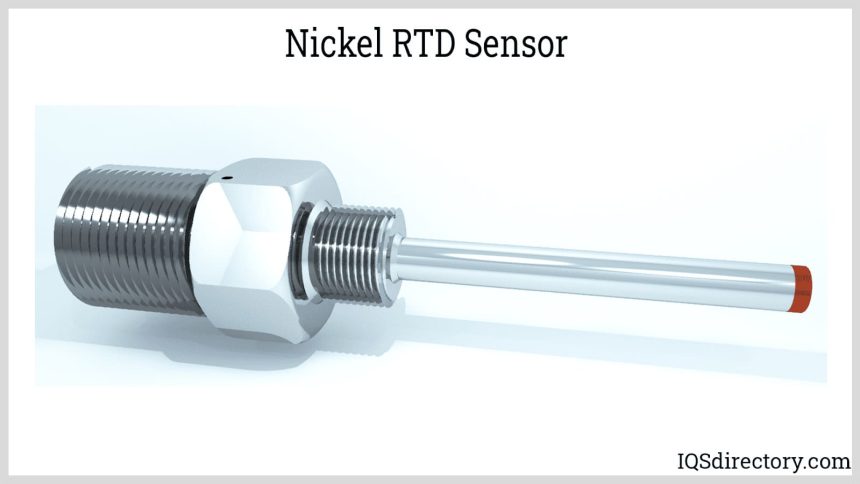
RTD (Resistance Temperature Detector) features a rugged design suitable for manufacturing environments that directly affect the RTD functioning and its life. RTD sensors have sensor elements that are typically designed either as wire-wound or thin-film. Wire-wound RTDs can’t be beaten for long-term accuracy and stability, while thin-films are faster and more resistant to vibration.
Probe construction is equally important. Depending on the temperature range, pressure, and chemical exposure, sheath materials (stainless steel, Inconel, or some ceramics) are selected. Insulation materials will need thermal cycling resistance, which could track temperature reading signals.
Lead wire configurations (2-wire, 3-wire, or 4-wire) also affect measurement accuracy; 3-wire and 4-wire designs compensate for lead resistance in industrial installations. Correct housing, connection heads, and mounting styles ensure the resistance temperature detector integrates smoothly with plant equipment.
Industrial Process Performance Benefits of RTDs
- Their biggest advantage is their accuracy and repeatability compared to thermocouples or thermistors. Such accuracy matters in processes where temperature tolerances can be quite small, but product quality is greatly affected by temperature.
- Another advantage is long-term stability. Due to their low drift, RTDs are suitable for continuous operations where the time between recalibrations must be extended.
- They also have an extensive temperature range, usually –200°C to 600°C, that accommodates most industrial applications.
- RTDs, or resistance temperature detectors, provide fast and reproducible feedback, which is essential for maintaining control systems, regulating heaters, coolers, and such processes that have been automated.
Reliability in Harsh Manufacturing Conditions
Manufacturing plants usually have tough operating environments with vibration, pressure variation, heat-shock, and chemicals. RTDs are designed to perform well in the presence of many of these stresses and in industrial environments. With good mechanical design, they are doable on vibrating systems from rotating machines and high-temperature process lines.
Appropriate packing materials and securing techniques protect against chemical substances. Ingress protection (IP) rating ensures that moisture, dirt, and other contaminants cannot affect the performance of sensors.
High manufacturing processes and well-defined calibration increase reliability. They do not express how the specifications are achieved over the lifetime, even for the most aggressive condition, but guarantee that the RTD resistance temperature detector specifications will be met during its lifetime.
Industrial Applications of RTDs in Manufacturing Plants
- Most manufacturing plants have temperature measuring and controlling equipment, such as RTDs (Resistance Temperature Detectors) and so on, placed in reactors, furnaces, heat exchangers, and pipelines. They serve as a vital link in automation systems by providing input to PLCs, DCSs, and SCADA systems.
- RTDs also help in quality assurance and safety monitoring — RTDs eliminate the failure by forecasting abnormal temperature conditions.
- They are in the toughest industries like chemical processing, pharmaceuticals, power generation, food processing, etc., where compliance, consistency, equipment, and personnel protection are second to none.
Choosing the Correct RTD for Industrial Applications
- Selecting a proper RTD depends on the required accuracy, the ambient temperature at which it will be operated, and the environmental and mechanical requirements.
- International standards are set by IEC and DIN, and they are similar in terms of track-and-trace ability.
- Pioneering the sensor design specific to the application (immersion, surface measurement, high-pressure system, etc.).
- Working with a reliable manufacturer ensures the years of performance you receive are backed by reliable technical support.
Final Words
RTD (Resistance Temperature Detector) offers a suitable design, performance, and stability to allow long-term temperature measurement in a manufacturing plant. The precision of these sensors in demanding operating conditions is crucial for operational efficiency and driving safety. Companies such as Tempsens, which have extensive experience in industrial temperature sensing and RTD manufacturing, offer bespoke solutions tailored to the strict requirements of sectors that demand top-level precision and accuracy, helping manufacturers maintain effective temperature control.