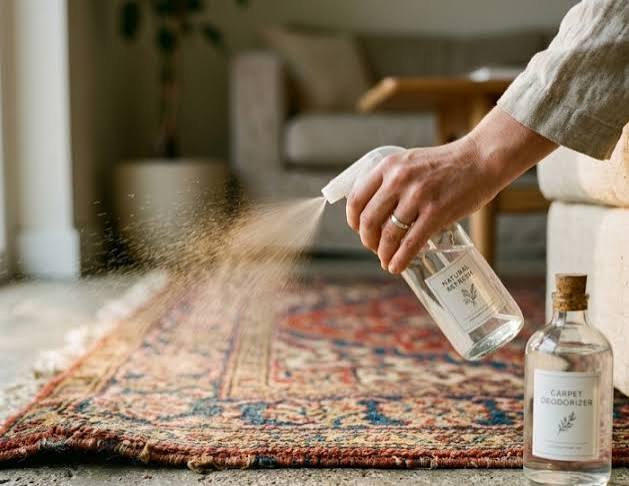
It’s time to start thinking of carpets as the massive and complex air filters for your home that they are. Because of their porous, fibrous structure, which is exactly what makes them both durable and comfortable, they are an incredibly efficient trap for microscopic particles.
Sadly, this is exactly what generates the smell you’re trying to eliminate. So, to truly refresh your home, you need to learn about the 9 specific ways your carpet is holding on to unwanted odours. That way, you’ll finally know what to do about them.
Let’s get into it!
- The Persistent Nature Of Pet Oils And Dander
Pets bring endless joy to our homes, but they also bring specific challenges. It is not just the pet hair that you can see on the surface, but also the oils produced by their skin and fur.
These oils are designed to keep their coats waterproof and healthy, but when they transfer to your carpet, they act like glue. They coat the carpet fibres, attracting dust, dirt, and bacteria, and sealing them into the fabric.
Over time, these organic oils go rancid. Because they are oily, they are hydrophobic, meaning water alone—or even a standard vacuum cleaner—cannot lift them out.
These oils penetrate deep into the carpet’s base, creating a persistent, musky odour that is difficult to eliminate with standard cleaning methods.
- Spilt Liquids That Sink Beneath The Fibres
Most homeowners react quickly to a spill by dabbing at the surface, but the physics of a carpet means that gravity is working against you.
When you spill a sugary drink, wine, or milk, the liquid doesn’t just sit on the surface, but it travels down the fibres into the carpet’s primary and secondary backing.
And, if the spill is significant, it can even soak into the underlay beneath the carpet. Once the moisture evaporates, the sugars or proteins remain behind. Needless to say, these substances start to decompose, feeding the bacteria that naturally live in the carpet environment.
This bacterial growth is the source of many “sour” smells that seem to emerge from the floor whenever the humidity rises.
- The Hidden World Of Underlay Absorption
The underlay, which is the foam or felt padding beneath your carpet, is essentially one giant sponge. Because it is porous and sits directly on the subfloor, it is perfectly positioned to absorb and hold onto everything that makes it through the carpet backing.
If you have had pets, persistent spills, or even just high-traffic usage for years, your underlay likely contains a concentrated collection of trapped odours. This is the “deep” layer of a carpet that a standard vacuum cleaner cannot even reach.
When you walk across the room, the carpet’s compression pushes air out of the underlay and into your room, effectively “pumping” stale, trapped odours into your living space.
- Tobacco Smoke And Resin Deposits
Tobacco smoke consists of thousands of particles, many of which are resinous and sticky. Even worse, when they settle onto a carpet, they don’t just sit there, but they bond with the synthetic or natural fibres.
Over time, these resins form a film that coats the carpet, trapping dust and other pollutants. So, the smell of stale tobacco is notoriously difficult to remove because it isn’t just a surface odour but one embedded in the material as well.
Even if you stop smoking in the room, the carpet continues to off-gas these trapped odours for years, creating a lingering, musty smell that feels ingrained in the very structure of the house.
- Dust And Allergen Accumulation
A carpet is often the largest dust-collection surface in a home.
While you might clear the visible surface dust with a hoover, you are likely missing the microscopic debris—dust mites, dead skin cells, pollen, and environmental pollutants—that settle deep in the pile.
These materials are organic, and as they break down, they produce faint, unpleasant odours.
Furthermore, carpets are excellent at trapping pollen brought in from outside. In the spring and summer, the carpet acts as a reservoir for these allergens.
If you notice your home smells “dusty” or “stuffy” despite a clean room, the issue is almost certainly the accumulation of a large amount of fine particulate matter at the base of the carpet fibres over many months.
- The Sticky Residue From Diy Cleaning Agents
Ironically, one of the most common reasons carpets hold on to smells is the attempt to clean them using improper methods.
Many DIY carpet cleaning sprays and foam shampoos are designed to leave a slight residue to help “brighten” the carpet or add a scent. However, this chemical residue is often sticky. It dries on the carpet fibres and acts like a magnet for dirt and dust.
When you walk on the carpet, you grind the fresh dirt into the sticky, old soap residue. This mixture creates a grey, dulling film that holds onto odours much more aggressively than clean, dry fibres ever would.
This is why many people find that their carpets smell “soapy” or “chemical” after a deep clean, only to find they smell worse than before once the residue collects new dirt.
- High Humidity And The Damp Effect
Carpet fibres, particularly those made from natural materials like wool, are hygroscopic, meaning they absorb moisture from the air. In a damp or poorly ventilated room, your carpet is constantly absorbing and releasing atmospheric moisture.
This cycle of wetting and drying promotes the growth of microscopic mould spores and bacteria. Even if there is no visible mould, the carpet is living in a state of semi-dampness that produces a “wet dog” or “mildew” smell.
If you live in a high-humidity area, or if you have a room that doesn’t get enough sunlight, your carpet is likely harbouring a damp, musty character, which is particularly noticeable on humid days.
- Fungal And Bacterial Colonies
When you combine organic matter (spills, skin cells, pet oils) with moisture, you have created a laboratory for microbial life.
Carpets are not sterile environments–far from it! They house colonies of bacteria and fungi that thrive on the organic debris trapped in the fibres.
These organisms release waste products as they consume debris, often in the form of odorous gases.
In most cases, these colonies are small and go unnoticed, yet they constantly emit a low-level scent. So, when the carpet is not regularly deep-cleaned, these colonies expand, and the smell becomes a permanent fixture of the room’s air quality.
- Airborne Contaminants Trapped By Fibres
Carpets essentially act as a giant air filter for your home, catching pollutants from the air, including cooking fumes, volatile organic compounds (VOCs) from furniture and paint, and general household odours.
Over time, the carpet becomes saturated with these airborne contaminants. This is why a carpet in a kitchen-adjacent area often smells different from a carpet in a bedroom. The fibres have physically trapped the airborne grease and food particles.
If you are struggling with a lingering odour and you have exhausted every other possibility, remember that your carpets have been silently filtering your home’s air for years.
Sometimes, only professional intervention can truly reset the environment. That’s why many residents rely on deep carpet cleaning solutions in St Albans to achieve the necessary extraction levels that DIY tools simply cannot match.
Professional-grade machines use high-pressure, hot-water extraction that reaches the base of the pile, flushing out deep-seated contaminants, oils, and residues that have been anchoring those smells to your home for so long.
Conclusion
As you can see, if there are persistent odours in your home, the most likely culprit is the flooring.
Now that you know that carpets tend to accumulate deep-seated build-up, which needs regular tending, you’ll easily restore the comfort of your home.
This will also extend the lifespan of your flooring and ensure you finally enjoy a place that is just as clean as it looks.