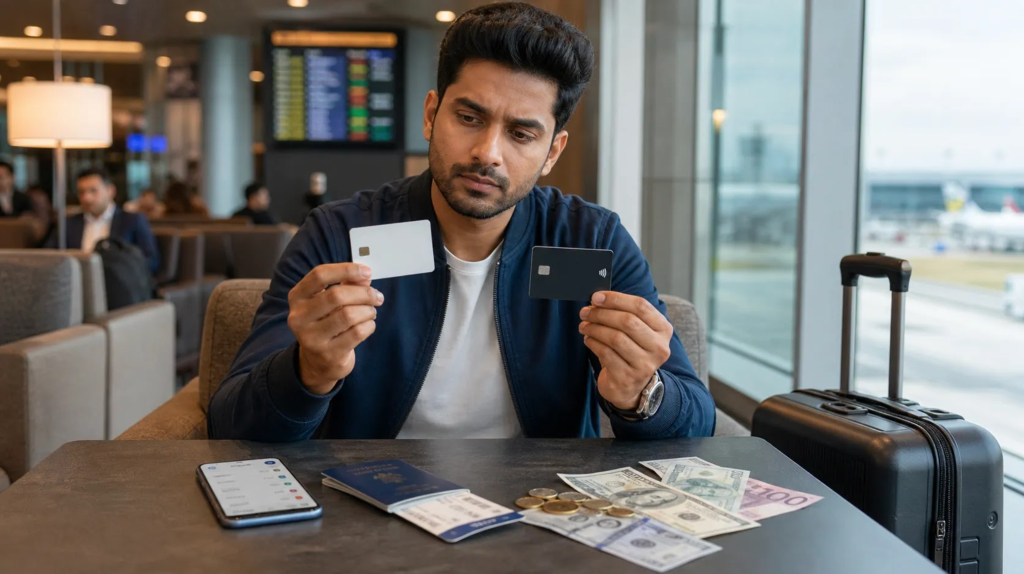
Imagine landing in Tokyo and heading straight to a cosy ramen shop that you’ve been looking forward to for months. You pay for your meal with your regular bank card, and it seems simple enough. But a few days later, you check your bank statement and see that one tap cost you an extra ₹150 in conversion fees and service charges. It might seem like a small amount that is easy to overlook, but over the course of your trip, these fees can add up. Before you know it, you’ve spent thousands more than you planned, even though you didn’t actually buy more.
The truth is, most travellers don’t overspend; rather, they overpay. That’s where forex cards come in. But even here, the choice isn’t as straightforward as travellers today often find themselves choosing between a free card and a paid card.
Knowing the difference between the two can make a real difference, not just for your budget but also for how smoothly your trip goes.
Understanding forex cards
A forex card works a lot like a debit card, where you preload the required amount. You can use it at restaurants, for shopping, to book activities, or to withdraw cash from ATMs while you’re abroad. Instead of carrying foreign currency in cash, you can use this card to pay directly in the local currency wherever you travel, making it a safer and more efficient payment method. But not all forex cards work the same way.
How they handle currency conversion and fees is what sets free forex cards apart from paid ones.
What is a free forex card?
It is a card that allows you to spend abroad without paying a markup fee on every transaction. Normally, banks charge a small markup between 2% and 5% every time you spend in a foreign currency. This charge is often hidden within the transaction amount, which is why many travellers don’t notice it immediately.
These cards offer zero forex markup. So, if you spend ₹10,000 abroad, you pay only the converted amount based on the exchange rate and no extra fees.
These cards are also issued without a joining or annual fee, which is why they are often referred to as lifetime free forex cards. They allow you to load money in INR and spend anywhere in the world. The card converts your money automatically in real time, so you don’t have to worry about planning or managing different currencies.
For most travellers, this makes things much easier as they don’t have to think about exchange rates, leftover money, or carrying different wallets. It’s simple and easy to use.
What is a paid forex card?
A paid forex card requires you to load money in a specific foreign currency, such as USD, EUR, or GBP, before your trip. Once loaded, you spend from that balance while travelling.
One advantage of this system is that you can lock in an exchange rate at the time of loading. This gives you a level of predictability, especially if you’re concerned about currency fluctuations.
Paid forex cards usually have fees like issuance charges, reload fees, currency conversion charges, and ATM withdrawal fees. Each fee might seem small, but together they can add up and make your trip more expensive.
These cards also need more planning. You have to figure out how much to load in each currency, keep track of your balances, and handle any leftover money after your trip.
Key differences between free and paid forex cards
The main differences between the two are cost, convenience, and flexibility.
- With free cards, you don’t have to worry about currencies or conversions because the card takes care of it for you. It is great for travellers who want things to be easy and clear.
- Paid cards give you more control over exchange rates, but you have to manage them more closely. You’ll need to plan ahead, keep an eye on your balances, and watch out for different fees.
For example, if you spend ₹2,00,000 on a trip, you could pay thousands of rupees in markup fees with a paid card, but a free forex card would save you most of that money.
Common mistakes to avoid
Even if you have the right card, small choices can still affect how much you spend –
- A common mistake is paying in INR when you’re abroad. It might seem easier, but you usually get a worse exchange rate. It’s always advised to pay in the regional currency.
- Another mistake is using only one card. It’s a good idea to carry a backup, since international transactions can sometimes fail because of network or security problems.
- Even if your card has zero forex markup, ATMs abroad might still charge their own transaction fees. To save money, keep atm withdrawals to a minimum.
How to choose the best free forex card?
When choosing a free forex card, look for one that’s clear about its fees and is easy to use.
Pick a card that truly offers zero forex markup with no hidden terms. The exchange rates should be clear and based on real-time conversions.
It’s also important to pick a card that’s easy to manage. Features like a good mobile app, instant reloads, and real-time tracking can make your trip much smoother.
In the end, the best free forex card is one that feels easy to use, so you don’t have to think about how it works every time you pay.
Final Thoughts
In today’s competitive digital world, free forex cards meet the expectations of travellers by reducing fees, simplifying usage, and offering greater flexibility. People are now opting mostly for a lifetime free forex card for its convenience and simplicity. Many are drawn to options marketed as “free,” but not every card that claims to be free is truly cost-effective in practice.
Alongside traditional forex cards, newer alternatives are gaining attention. One such option is Niyo’s zero forex markup card, which does not require preloading foreign currency and allows users to spend internationally directly in INR with zero markup fees, offering a more streamlined approach to global payments.
So before your next trip, take a closer look at how your current card charges you. Sometimes, the difference between a good trip and a great one isn’t where you go, but how smartly you spend while you’re there.